





Good health generally requires good oral hygiene (in adults and children). Our teeth can in fact be the cause of many inconveniences and are the gateway to multiple infections. Teaching our children good oral hygiene habits from an early age could allow them to maintain a healthy smile and teeth throughout their lives and save them from numerous visits to the dentist. Our advice for keeping your teeth healthy.

Tooth brushing in children: when to start? And with which toothbrush?
This is an essential question that many parents ask themselves: when should you start brushing your baby’s teeth? From their first appearance, generally around the age of 6 months, infants’ milk teeth present a risk of decay, often called “baby bottle tooth decay”. This baby tooth decay most often appears in the upper incisors, but other teeth can also be affected. It is therefore important to adopt good oral hygiene habits from the first days of your baby’s life by gently wiping his gums with a damp compress. As soon as the teeth appear, you can clean the baby’s teeth morning and evening with a toothbrush suitable for the size of the child and water. Brushing children’s teeth with toothpaste can start around the age of two, morning and evening, always with an ecological toothbrush suitable for children.
How to properly brush children’s teeth? What oral hygiene should you adopt?
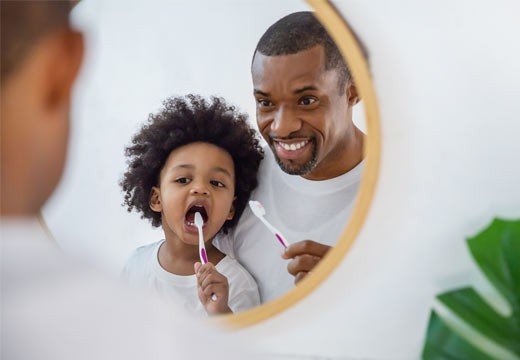
Brushing your teeth is recommended twice a day, after breakfast and after dinner, for at least 2 minutes. Apply the toothpaste to the toothbrush, without wetting it, and brush starting from the gum and going down (or up for the bottom) towards the teeth. Be sure to brush in front and behind your teeth. You can also brush your tongue.
When you brush your child’s teeth, explain each action clearly to them so that they assimilate the gestures and vocabulary. Gradually, at an older age, let your child do it on his own and be sure to teach him how to spit out the toothpaste. Parents’ teeth can be brushed at the same time as your child to show them an example of good dental hygiene and good habits to adopt. Choosing a toothbrush is also a way to make brushing your teeth more fun. Your child will prefer one color over another. Let’s forget the threat of the dentist and let him choose his toothbrush!
Do not hesitate to reread our advice for good dental hygiene and discover tips for brushing your teeth in a gentle and natural way and choosing your adult toothpaste.
Which children’s toothpaste to choose?
To help your child adopt good oral hygiene practices, you should choose a toothpaste that is appropriate for their age and meets several criteria:
– Opt for one organic children’s toothpaste in order to avoid any unwanted substances coming into contact with its fragile oral mucosa. Indeed, a classic toothpaste for children often contains petrochemical derivatives, synthetic preservatives not authorized in the specifications of organic products (butylparaben, propylparaben, etc.) as well as synthetic colorings and perfumes…
– Favor one children’s toothpaste without or with little fluoride : toothpastes for children are generally formulated with little or no fluoride, which is harmful to their teeth during the mineralization period. Indeed, excess fluoride in children can alter the appearance of teeth (discoloration, presence of small brownish streaks).
– Choose one toothpaste taste which appeals to children so that they brush their teeth regularly and enjoy the moment of brushing their teeth.
– Pay attention to the packaging of toothpaste: opt for one child toothpaste tube guaranteed without phthalate or Bisphenol A.
After 6 years, children can use the same toothpaste as adults.
How to recognize organic children’s toothpaste?

To recognize an organic toothpaste, look for the Cosmos organic logo on the packaging. This label is issued by independent organizations such as Cosmébio or Ecocert, which guarantee their compliance with very strict specifications. They contain 95% or more ingredients of natural origin and at least 10% ingredients from Organic Farming. Children’s toothpastes are generally formulated with plant extracts, trace elements or even specific active ingredients such as Xylitol. Your children’s teeth will thank you.